

General information
For terminal bars (and the terminal blocks they contain), the program calculates an automatic size that depends on the type and quantity of terminal bars they contain.
he aim of the calculation is to reserve sufficient space for terminal bars. It is rounded up deliberately to avoid undesirable space problems later when building the switch cabinet.
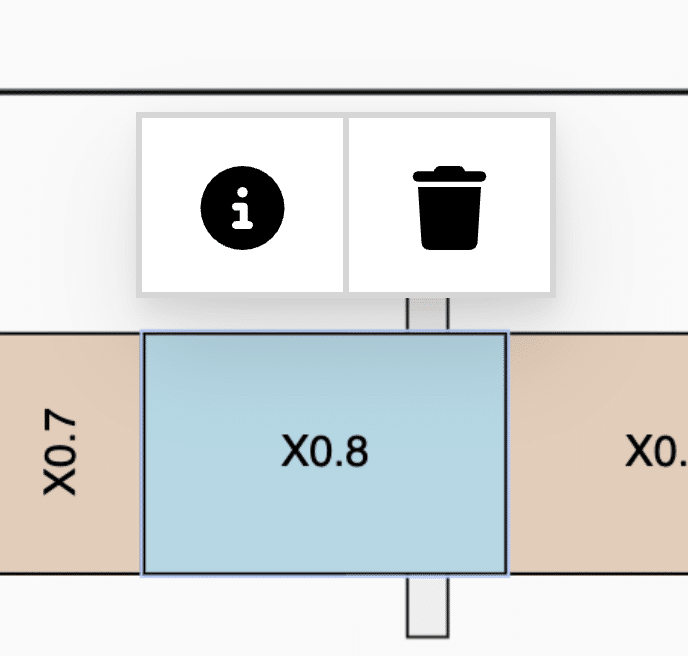
If you select a terminal bar in the enclosure layout, you can open a dialog via the info icon that shows you the calculation result:
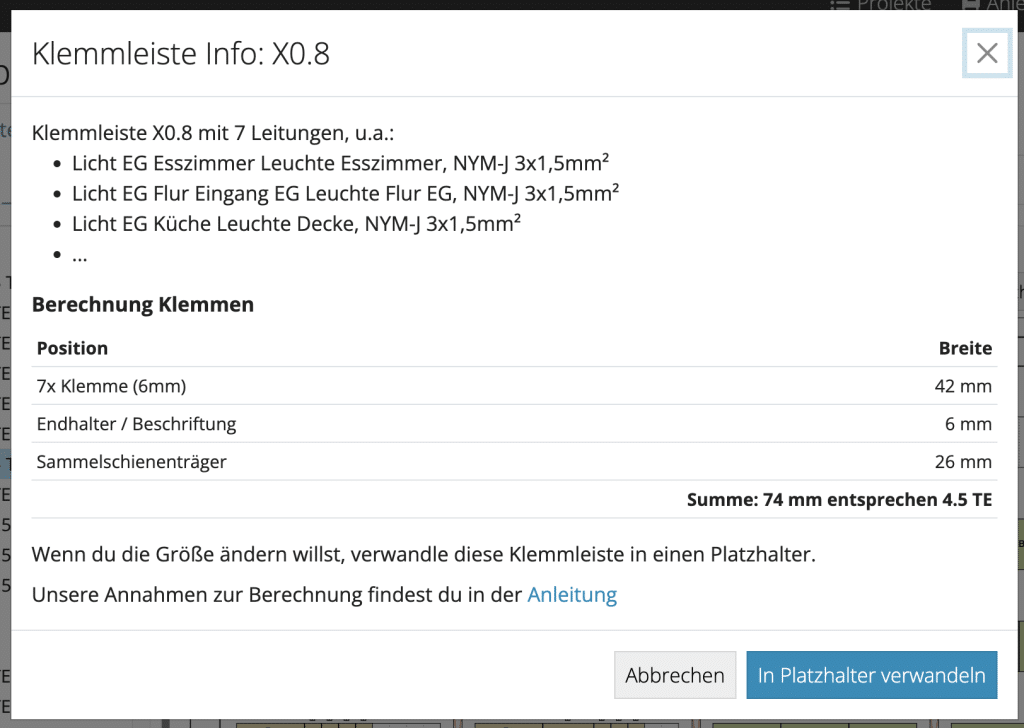
If you are not happy with the size calculation, you can select the option “convert to placeholder” via the dialog or by right-clicking on a terminal bar in the tree. This creates a placeholder of (initially) the same size. Double-click on the placeholder to change the size manually.

Goal of the automatic calculations
There are a few important goals for the calculation that I would like to summarise in more detail:
- The calculation is optimised for planning new state-of-the-art distribution systems
- Terminal bars can also always be designed using placeholders => you can then plan freely in a 0.5 modules grid if the calculation for older systems does not fit.
- No over-optimisation to mm:
- You always plan a new distribution board with a bit of ‘breathing space’, things always change on the construction site, so you don’t want to end up with a distribution board that is too small. A ‘little’ too big (1-2 modules) is always okay.
- Target group: Planners who want to plan quickly and pragmatically. Time is money -> generalised approaches are more important than detailed planning
- Generalised approaches and standards beat checkboxes for fine-tuning
- An important feature of wiring-diagram.com has always been: you cannot customise everything -> but what you design will work in many cases. This means that diagrams can be created quickly and pragmatically with just a few clicks. If you need finer planning details, you should purchase a CAD programme as a supplement.
- The calculation should work equally well enough for Wago or Phoenix
Formulas for calculating the size of terminal bars
The following calculations can currently be made:
- The number of terminal blocks required for each terminal bar is first calculated
- For 230V, L/N/PE terminals are always used, then additional LL terminals (see below for special cases)
- For 24V and KNX with simple LL terminals
- If you use the “Modules calculation” export under Exports, you will find a spreadsheet where you can see the distribution of the terminals
- für Klemmen <=2.5 mm² Querschnitt:
- Terminals are recognised with a standard width of 6 mm. This is suitable for Wago and also Phoenix and a separator plate here and there.
- If there are more than 4 (L/N/PE) terminals in a terminal bar, a busbar is used in the calculation.
- Generalised approach: 1.5 HP // 26 mm on top. Sufficient for one N-disconnect terminal + 1-2 busbar supports
- With max. 4 (L/N/PE) terminals, it assumes that these are simply bridged, no busbar supplement
- But: if there are too many (>=2) L/L terminals in between, then we will use the busbar anyway
- No busbar for 24V or bus systems (they also have no L/N/PE terminals)
- für Klemmen >2,5mm² Querschnitt -> wird nicht mehr mit Doppelstockklemmen gerechnet, jede Ader bekommt eine eigene Klemme
- 4.0/6.0 mm² RK have a width of 6.2 mm
- 6.0/10.0 mm² RK have a width of 7.5 mm
- 10/16 mm² RK have a width of 10 mm
- 16/25mm² RK have a width of 12mm
- A general 1 mm is added to each terminal: this covers the fact that a separator plate or separator wall is placed here and there
- KNX (feed-through) terminals are set at 4 mm.
- Both Wago and Phoenix offer different terminal types for KNX cables. These are usually narrower and enable a large number of KNX cables to be bridged in a small space. In our experience, a calculation of 4 mm per (double feed-through) terminal fits very well as a general rule for the various available systems.
- Each terminal bar always has an extra 6 mm for an end clip for labelling
- After the calculation is complete, the grid is rounded up to 0.5M.
